
Exosomes & Stem Cells: Benefits and Dangers
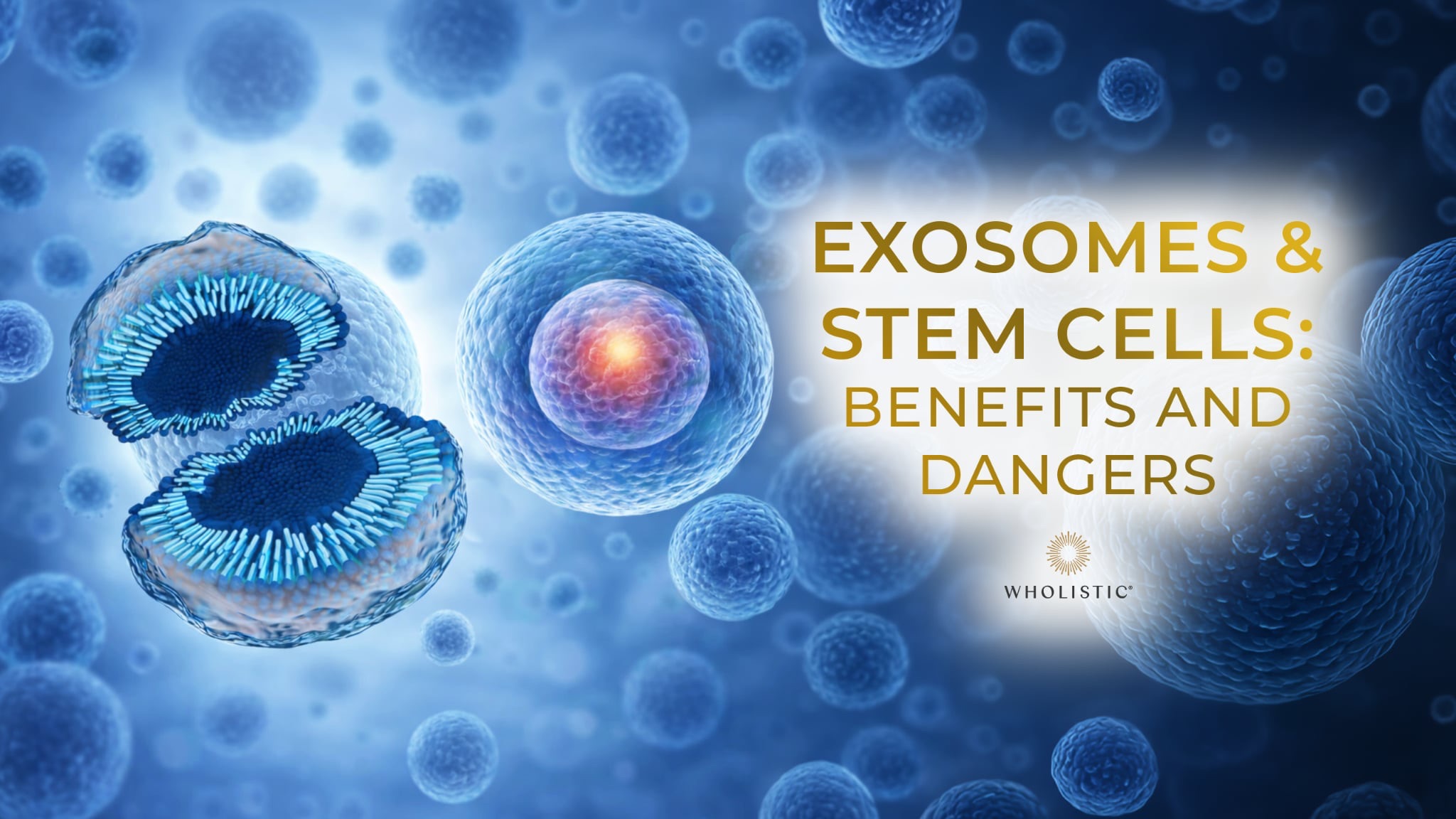
Stem cell therapy has become one of the most visible trends in modern medicine.
From anti-aging clinics to biohacking retreats to celebrities flying around the world for regenerative injections, stem cells and exosomes are being promoted as the future of longevity.
You hear:
“Reverse biological age.”
“Reset your immune system.”
“Regenerate at the cellular level.”
But stem cells and exosomes are not cosmetic interventions.
They are powerful biological tools that influence gene expression, immune function, angiogenesis, and cellular replication.
Before considering regenerative therapy — especially for anti-aging — it is critical to understand what these therapies actually are, how they work, and what long-term data we do and do not have.
Understanding the Different Types of Stem Cells
Not all stem cells are the same. Their source determines both benefit and risk.
Autologous Stem Cells (Your Own Cells)
Harvested from your bone marrow or adipose tissue.
Commonly used for orthopedic injuries.
Advantages:
-
No graft-versus-host disease
-
Minimal immune rejection
Limitations:
-
Aging cells carry accumulated DNA damage
-
Reduced regenerative capacity over time
-
Inflammatory burden affects cell quality
Autologous therapy avoids foreign immune reaction — but it does not eliminate biological complexity.
Allogeneic Stem Cells (Donor-Derived)
Derived from:
-
Umbilical cord tissue
-
Placenta
-
Donor bone marrow
-
Wharton’s jelly
Commonly used in longevity and systemic IV infusion protocols.
Even when described as “immune privileged,” donor cells are still foreign biological material.
Potential risks include:
-
Immune sensitization
-
Delayed inflammatory reactions
-
Antibody formation
-
Subtle long-term immune modulation
Immune suppression is not typically long-term in anti-aging settings — but immune signaling is still altered.
Mesenchymal Stem Cells (MSCs)
The most widely marketed regenerative cells.
They primarily function through signaling, not structural rebuilding.
They:
-
Release cytokines
-
Modulate immune response
-
Promote angiogenesis
-
Influence inflammation
That signaling capacity is central to both potential benefit and risk.
Embryonic Stem Cells
Pluripotent and capable of becoming nearly any cell type.
This power carries documented risks:
-
Teratoma (tumor) formation
-
Uncontrolled differentiation
-
Immune rejection
Because of tumorigenic potential, embryonic stem cells are largely restricted to controlled research settings.
Pluripotency is powerful — but difficult to regulate safely.
VSELs (Very Small Embryonic-Like Stem Cells)
VSELs are small stem cell-like populations found in adult tissues.
They are proposed to:
-
Exhibit pluripotent-like qualities
-
Represent a dormant regenerative reserve
Their small size may reduce mechanical vascular obstruction risk compared to larger MSCs.
However:
-
Large-scale long-term human safety data is limited
-
Standardized protocols are not universal
-
Cancer surveillance data is absent
Some researchers, including Dr. Todd Ovokaitys, have explored activation approaches for VSEL populations. These remain investigational.
Exosomes: The “Cell-Free” Alternative
Exosomes are extracellular vesicles released by cells, including stem cells.
They carry:
-
microRNA
-
mRNA
-
Growth factors
-
Proteins
They alter gene expression and immune signaling.
Because they do not replicate, they are marketed as safer than stem cells.
However:
-
They still modify cellular programming
-
They influence immune pathways
-
They interact with tumor microenvironments
-
They affect angiogenesis
Cancer biology research shows exosomes play a role in metastasis and tumor signaling.
We do not have multi-decade safety data for systemic exosome therapy in healthy anti-aging patients.
Stem Cells for Anti-Aging: What Is Actually Proven?
Currently:
-
No stem cell therapy is FDA-approved for aging.
-
No large randomized trials demonstrate lifespan extension.
-
Long-term cancer surveillance in healthy recipients is lacking.
Short-term improvements in energy or inflammatory markers do not equate to validated longevity.
Aging involves:
-
DNA damage accumulation
-
Stem cell exhaustion
-
Cellular senescence
-
Immune remodeling
-
Mitochondrial decline
These are complex, multi-system processes.
Cancer Risk: The Most Important Question
Stem cells self-renew and differentiate.
Cancer cells do the same.
Potential concerns include:
-
Promotion of angiogenesis
-
Modulation of tumor microenvironments
-
Suppression of immune tumor surveillance
-
Activation of dormant malignancy
We do not yet have 15–20 year cancer incidence data in healthy anti-aging stem cell recipients.
Absence of long-term tracking is a critical unknown.
Immune Suppression in Anti-Aging Settings
In hospital-based bone marrow transplant:
-
Immunosuppressants are used for 6–12 months or longer.
-
Drugs include tacrolimus, cyclosporine, mycophenolate, corticosteroids.
In anti-aging clinics:
-
Long-term immunosuppression is generally not used.
-
Short-term corticosteroids (3–14 days) may be used.
-
Some protocols incorporate low-dose immune-modulating agents such as rapamycin.
Even without pharmaceutical immunosuppressants, stem cells and exosomes inherently modulate immune signaling.
Immune surveillance protects against:
-
Infection
-
Viral reactivation
-
Emerging malignancy
Altering immune balance carries biological trade-offs.
Thrombotic and Vascular Risk
IV MSC infusions may:
-
Activate clotting pathways
-
Cause microvascular obstruction
-
Increase pulmonary embolism risk
MSCs express tissue factor, which can initiate coagulation cascades.
Dose, route, and patient risk factors matter significantly.
The Celebrity & Influencer Effect
You see celebrities and influencers flying to clinics around the world for stem cell injections.
They often report:
-
Increased energy
-
Faster recovery
-
Feeling “younger”
But what is rarely discussed publicly:
-
What exact product was used?
-
Was it donor-derived?
-
Were exosomes included?
-
Was immune modulation involved?
-
What long-term cancer monitoring is planned?
Short-term improvement does not answer long-term biological safety.
Visibility is not validation.
Social media timelines move faster than immune remodeling and cancer biology.
Why People Follow the Trend
Drivers include:
-
Fear of aging
-
Desire for control
-
Biohacking culture
-
High-profile testimonials
-
Early-adopter psychology
These motivations are human.
But longevity decisions should not be made based on trend momentum alone.
Medical Tourism: An Added Variable
Some individuals travel internationally for regenerative therapy due to regulatory differences.
Important considerations include:
-
Laboratory standards
-
Donor screening
-
Sterility protocols
-
Legal recourse
-
Long-term follow-up
Safety depends more on protocol integrity than geography.
The Most Important Category: The Unknown
We currently lack:
-
Multi-decade cancer surveillance data
-
Long-term immune remodeling studies
-
Large randomized anti-aging trials
-
Comprehensive epigenetic tracking
Longevity interventions must be evaluated over lifetimes.
Biology unfolds slowly.
The Responsible Approach: Individualized Precision Before Intervention
Before investing in high-cost regenerative therapy, consider:
-
Is your immune system balanced?
-
Is chronic inflammation driving accelerated aging?
-
Are hidden infections or toxic exposures present?
-
Is mitochondrial function optimized?
-
Is nervous system regulation addressed?
Regenerative therapy does not replace foundational precision.
Often, addressing root causes can dramatically improve vitality without invasive cellular intervention.
A Thoughtful Invitation
If you are considering stem cell or exosome therapy — especially for anti-aging — I encourage you to seek individualized clarity first.
In a Quantum Health appointment, we assess:
-
Immune resilience
-
Inflammatory drivers
-
Toxic burden
-
Mitochondrial health
-
Nervous system stress patterns
-
Underlying terrain imbalances
Before making a significant financial and biological investment, precision matters.
Longevity is not a trend.
It is a long-term strategy.
And the most powerful regenerative intervention may be optimizing your body’s own innate healing systems first.

Final Perspective
Stem cells and exosomes represent extraordinary scientific progress.
Some applications are validated.
Many remain investigational.
Regeneration is powerful.
And powerful biology deserves humility, education, and informed decision-making.
Hope is important.
But literacy protects your future.
References
-
National Eye Institute, National Institutes of Health. Putting Stem Cell-Based Therapies in Context. Published November 16, 2022. Accessed February 15, 2026. https://www.nei.nih.gov/research-and-training/research-news/putting-stem-cell-based-therapies-context
-
U.S. Food and Drug Administration. Important Patient and Consumer Information About Regenerative Medicine Therapies. Updated June 3, 2021. Accessed February 15, 2026. https://www.fda.gov/vaccines-blood-biologics/consumers-biologics/important-patient-and-consumer-information-about-regenerative-medicine-therapies
-
U.S. Food and Drug Administration. Consumer Alert on Regenerative Medicine Products Including Stem Cells and Exosomes. Updated July 22, 2020. Accessed February 15, 2026. https://www.fda.gov/vaccines-blood-biologics/consumers-biologics/consumer-alert-regenerative-medicine-products-including-stem-cells-and-exosomes
-
U.S. Food and Drug Administration. Public Safety Notification on Exosome Products. December 6, 2019. Accessed February 15, 2026. https://www.fda.gov/vaccines-blood-biologics/safety-availability-biologics/public-safety-notification-exosome-products
-
U.S. Food and Drug Administration. Public Safety Alert Due to Marketing of Unapproved Stem Cell and Exosome Products. December 9, 2019. Accessed February 15, 2026. https://www.fda.gov/safety/medical-product-safety-information/public-safety-alert-due-marketing-unapproved-stem-cell-and-exosome-products
-
U.S. Food and Drug Administration. Reporting Adverse Events Related to Stem Cells, Exosomes, or Other Products Marketed as Regenerative Medicine Therapies. July 22, 2020. Accessed February 15, 2026. https://www.fda.gov/vaccines-blood-biologics/consumers-biologics/reporting-adverse-events-related-stem-cells-exosomes-or-other-products-marketed-regenerative
-
Nelson RM. Overview of FDA Perspective on the Ethics of Stem Cell Therapy. U.S. Food and Drug Administration; presented April 4, 2010. Accessed February 15, 2026. https://www.fda.gov/media/85776/download
-
The Pew Charitable Trusts. Harms Linked to Unapproved Stem Cell Interventions Highlight Need for Greater FDA Enforcement. Issue Brief. June 1, 2021. Accessed February 15, 2026. https://www.pew.org/en/research-and-analysis/issue-briefs/2021/06/harms-linked-to-unapproved-stem-cell-interventions-highlight-need-for-greater-fda-enforcement
-
Petrus-Reurer S, Romano M, Howlett S, et al. Immunological considerations and challenges for regenerative cellular therapies. Commun Biol. 2021;4:798. doi:10.1038/s42003-021-02237-4. https://www.nature.com/articles/s42003-021-02237-4
-
Masouridi-Levrat S, Simonetta F, Chalandon Y. Immunological basis of bone marrow failure after allogeneic hematopoietic stem cell transplantation. Front Immunol. 2016;7:362. doi:10.3389/fimmu.2016.00362. https://www.frontiersin.org/journals/immunology/articles/10.3389/fimmu.2016.00362/full
-
Li SC, Zhong JF. Twisting immune responses for allogeneic stem cell therapy. World J Stem Cells. 2009;1(1):30-35. PMCID: PMC2958105. https://pmc.ncbi.nlm.nih.gov/articles/PMC2958105/
-
Mattsson J, Ringdén O, Storb R. Graft failure after allogeneic hematopoietic cell transplantation. Biol Blood Marrow Transplant. 2008;14(Suppl 1):165-170. doi:10.1016/j.bbmt.2007.10.025. https://pmc.ncbi.nlm.nih.gov/articles/PMC2344125/
-
Dana-Farber Cancer Institute. Is There a Risk of Immune Rejection From Stem Cell Transplants? April 19, 2023. Accessed February 15, 2026. https://blog.dana-farber.org/insight/2023/04/is-there-a-risk-of-immune-rejection-from-stem-cell-transplants/
-
Hoang VT, Le DS, Hoang DM, et al. Impact of tissue factor expression and administration routes on thrombosis development induced by mesenchymal stem/stromal cell infusions: re-evaluating the dogma. Stem Cell Res Ther.2024;15:56. doi:10.1186/s13287-023-03582-3. https://pmc.ncbi.nlm.nih.gov/articles/PMC10900728/
-
Moll G, Ankrum JA, Olson SD, et al. Improved MSC minimal criteria to maximize patient safety: a call to embrace tissue factor and hemocompatibility assessment of MSC products. Stem Cells Transl Med. 2022;11(1):2-13. doi:10.1093/stcltm/szab005. https://academic.oup.com/stcltm/article/11/1/2/6524224
-
Guillamat-Prats R. Role of mesenchymal stem/stromal cells in coagulation. Int J Mol Sci. 2022;23(18):10393. doi:10.3390/ijms231810393. https://www.mdpi.com/1422-0067/23/18/10393
-
Wang CK, Balakrishnan B, Lin W, et al. Regulation of exosomes as biologic medicines: regulatory challenges faced in exosome development and manufacturing processes. Ther Deliv. 2024. PMCID: PMC11307316. https://pmc.ncbi.nlm.nih.gov/articles/PMC11307316/
-
Dai J, Su Y, Zhong S, et al. Exosomes: key players in cancer and potential therapeutic strategy. Signal Transduct Target Ther. 2020;5:145. Published August 5, 2020. https://www.nature.com/articles/s41392-020-00261-0
-
Ye Z, Li G, Lei J. Influencing immunity: role of extracellular vesicles in tumor immune checkpoint dynamics. Exp Mol Med. 2024;56:2365-2381. doi:10.1038/s12276-024-01340-w. https://www.nature.com/articles/s12276-024-01340-w
-
Wortzel I, Dror S, Kenific CM, Lyden D. Exosomes in cancer development, metastasis, and immunity. Biochim Biophys Acta Rev Cancer. 2019;1871(2):455-468. doi:10.1016/j.bbcan.2019.04.004. https://pmc.ncbi.nlm.nih.gov/articles/PMC6542596/
-
Wright A, Snyder O, He H, et al. Lethal pulmonary thromboembolism in mice induced by intravenous human umbilical cord mesenchymal stem cell-derived large extracellular vesicles in a dose- and tissue factor-dependent manner. [Journal/Year as listed in PMC]. PMCID: PMC11489411. Accessed February 15, 2026. https://pmc.ncbi.nlm.nih.gov/articles/PMC11489411/
-
[Muse cells—clinical discussion] Donor Muse Cell Treatment Without HLA-Matching Tests and Immunosuppressant Treatment. Stem Cells Translational Medicine. 2024;13(6):532-[pages]. Accessed February 15, 2026. https://academic.oup.com/stcltm/article/13/6/532/7638780
-
[Muse cells—review] Macrophage- and pluripotent-like reparative Muse cells are unique endogenous stem cells distinct from other somatic stem cells. Front Bioeng Biotechnol. 2025. Accessed February 15, 2026. https://www.frontiersin.org/journals/bioengineering-and-biotechnology/articles/10.3389/fbioe.2025.1553382/full
-
Comparison of MSCs and Muse cells: the possible use for healthspan optimization. [Journal/Year as listed in PMC]. PMCID: PMC12222320. Accessed February 15, 2026. https://pmc.ncbi.nlm.nih.gov/articles/PMC12222320/
-
Ratajczak MZ, Ratajczak J, Kucia M. Very small embryonic-like stem cells (VSELs). Circ Res. 2019;124(2):208-210. doi:10.1161/CIRCRESAHA.118.314287. https://pubmed.ncbi.nlm.nih.gov/30653438/
-
Ratajczak MZ, Zuba-Surma EK, Shin DM, Ratajczak J, Kucia M. Very small embryonic-like (VSEL) stem cells in adult organs and tissues. Leukemia. 2014. Accessed February 15, 2026. https://www.nature.com/articles/leu2013255
-
Ratajczak MZ, Zuba-Surma EK, Wojakowski W, et al. Very small embryonic-like stem cells: characterization and biological significance. [Original article in PMC] 2008. PMCID: PMC2430762. https://pmc.ncbi.nlm.nih.gov/articles/PMC2430762/
-
Bhartiya D. Very small embryonic-like stem cells have the potential to win the “stem cell therapy” race: a perspective. [Journal/Year as listed in PMC] 2023. PMCID: PMC9846763. https://pmc.ncbi.nlm.nih.gov/articles/PMC9846763/
-
Thetchinamoorthy K, et al. Very small embryonic-like stem cells (VSELs) on the way for potential applications in regenerative medicine. Front Bioeng Biotechnol. 2025. Accessed February 15, 2026. https://www.frontiersin.org/journals/bioengineering-and-biotechnology/articles/10.3389/fbioe.2025.1564964/full
-
Hollands P, Aboyeji DR, Ovokaitys T. The action of modulated laser light on human very small embryonic-like (hVSEL) stem cells in platelet rich plasma (PRP). CellR4. 2020;8:e2990. https://www.cellr4.org/wp-content/uploads/sites/2/2020/12/e2990.pdf
-
Hollands P, Ovokaitys T. Human very small embryonic-like (hVSEL) stem cells: little miracles. CellR4.2022;10:e3304. doi:10.32113/cellr4_20225_3304. https://www.cellr4.org/wp-content/uploads/sites/2/2022/05/e3304.pdf
-
Hollands P. New concepts in the manipulation of the aging process. [Journal as indexed in PubMed]. 2024. PMID: 36752298. https://pubmed.ncbi.nlm.nih.gov/36752298/
-
Turner L. The American stem cell sell in 2021: U.S. businesses selling unlicensed and unproven stem cell interventions. Cell Stem Cell. 2021. https://pubmed.ncbi.nlm.nih.gov/34739831/
-
CalMatters. Court ruling gives FDA power over unproven California stem cell therapies. October 2024. Accessed February 15, 2026. https://calmatters.org/health/2024/10/stem-cell-therapy-fda/
-
Vox. Stem cell therapy: FDA investigates clinics offering unproven treatments. January 9, 2019. Accessed February 15, 2026. https://www.vox.com/2019/1/9/18173772/stem-cell-therapy-fda
-
Federal Trade Commission. Stem Cell Institute co-founders and companies banned from marketing stem cell treatments and ordered to pay more than $5.1 million. January 8, 2025. Accessed February 15, 2026. https://www.ftc.gov/news-events/news/press-releases/2025/01/stem-cell-institute-co-founders-companies-banned-marketing-stem-cell-treatments-ordered-pay-more-51

Hi, I’m Elena Bensonoff, Quantum Medicine Expert.
Here at Wholistic, our vision is to help facilitate the healing process so that you can reconnect with your authentic, whole self. So often, the root cause of physical or emotional imbalances is embedded in negative emotions that block the flow of energy in the body—increasing the likelihood of chronic pain, anxiety, and disease.
We recognize and honor your life path and are here to guide you to your own mastery.

Discover 3 powerful ways to bring health & vitality into your everyday life in Elena's FREE Masterclass!
Recent Posts
Discover Three Powerful Ways to Bring Health & Vitality Into Your Everyday Life in This FREE Masterclass by Worldwide Master Practitioner In Wholistic Healing, Elena Bensonoff.
Sign Up for the Masterclass below:

Join Elena Bensonoff In This Extraordinary Demonstration, And Discover Your Inner Healing Abilities To Heal And Rejuvenate Yourself.

